Your IT budget probably looks like a box of mystery chocolates. You never know what you will get. And it is rarely what you wanted. An unexpected server failure here. An emergency contractor invoice there. A license for software nobody uses anymore. Sound familiar? For a growing company, this is where Microsoft 365 small business plans change the conversation. They were designed to end that kind of financial anxiety. This guide explains how. In plain English. No tech degree required.
💰 Ready to trade IT surprises for predictable monthly costs?
We work with CFOs and business owners across the US. We right-size Microsoft 365 plans, eliminate hidden costs, and make cloud IT make financial sense.
📅 Book a Free 30-Min Call | 💬 Chat on WhatsApp | See Our Plans →

⚠️ The Hidden Cost of Traditional IT for Small Business
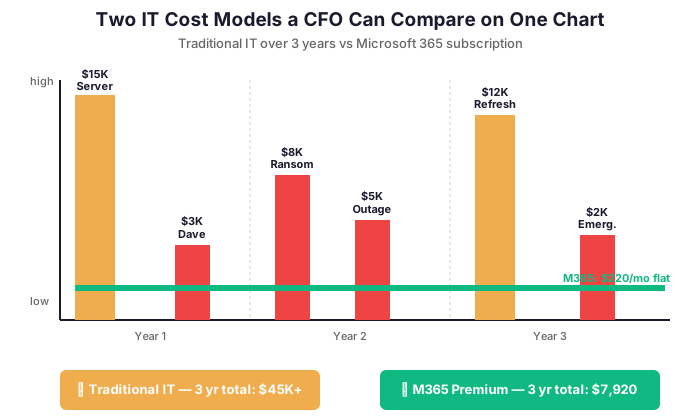
Before cloud solutions existed, businesses maintained physical servers. They paid for annual software licenses. They hired IT staff to keep everything running. Then they crossed their fingers that nothing would break at 4:59 PM on a Friday. (It always did.) Furthermore, the financial unpredictability was baked into the model. Capital expenses for hardware. Emergency support calls. Software upgrades every few years. Whether you needed them or not.
For a small business or a growing firm, this model punishes success. More employees mean more servers and more licenses. More complexity. As a result, costs scale in jumps rather than smoothly. And the budget spreadsheet gets progressively more creative.
♻️ Microsoft 365 Small Business: The Subscription Model That Actually Makes Sense
In contrast, Microsoft 365 small business plans replace all of that. You get a simple, per-user monthly subscription. You know what you are paying every month. Add a team member? Add one license. Lose a team member? Remove one license. Moreover, there is no hardware to depreciate. No major upgrade bills every three years. No infrastructure to maintain. For most finance teams, the predictability alone is worth the switch.
The typical Microsoft 365 Business Premium subscription runs around $22 per user per month. For that, every user gets professional email, Teams, Word, Excel, PowerPoint, SharePoint, cloud storage, and enterprise-grade security tools. Five years ago, deploying all of that on-premises would have cost ten times as much. Indeed, that is not a typo.
📦 What is Actually Included (The Good Stuff)
| M365 component | What it replaces | Typical standalone cost per user/month |
|---|---|---|
| ✉️ Email on your domain | Google Workspace or Gmail upgrade | $6 – $12 |
| 💬 Microsoft Teams | Zoom Pro + Slack Business | $15 + $8 |
| 📂 SharePoint + OneDrive | Dropbox Business, Box, shared drive | $15 – $20 |
| 📝 Office apps (Word, Excel, etc.) | Standalone Office licence | $10 – $15 |
| 📱 Intune device management | Third-party MDM tool | $6 – $10 |
| 🔐 Defender + MFA | Okta, 1Password Business, EDR suite | $10 – $20 |
| 📑 Compliance + DLP | Dedicated compliance add-on | $5 – $10 |
- Business email on your domain — professional addresses, not yourname@gmail.com
- Microsoft Teams — meetings, chat, file sharing, and phone calls in one place
- SharePoint — a proper document management system that replaces the chaotic shared drive
- Microsoft Intune (Business Premium) — manage all company devices remotely, including wiping a stolen laptop
- Advanced security — multi-factor authentication, anti-phishing, and data loss prevention
- 99.9% uptime SLA — Microsoft guarantees it, in writing
📊 The ROI Calculation Nobody Talks About
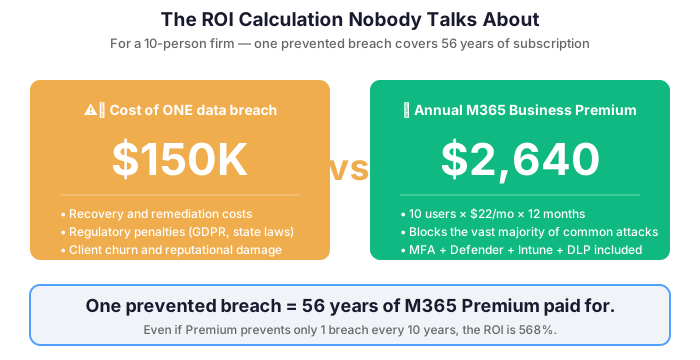
Finance teams love ROI calculations. Here is a simple one. A data breach affecting a 10-person firm costs an average of $150,000 in recovery, regulatory penalties, and reputational damage. However, Microsoft 365 Business Premium prevents the vast majority of common attacks. At $22 per user per month for 10 users, that works out to $2,640 per year. You dramatically reduce a $150,000 risk exposure. Consequently, even the most skeptical CFO appreciates that conversation.

Additionally, a Microsoft 365 small business setup eliminates the productivity tax of bad tools. Employees cannot find documents. They spend hours managing email on disconnected systems. That lost time costs real money. Together, SharePoint and Teams turn document chaos into structured collaboration. The productivity gains typically exceed the subscription cost within the first quarter.
🌿 Right-Sizing Your Microsoft 365 Small Business Plan
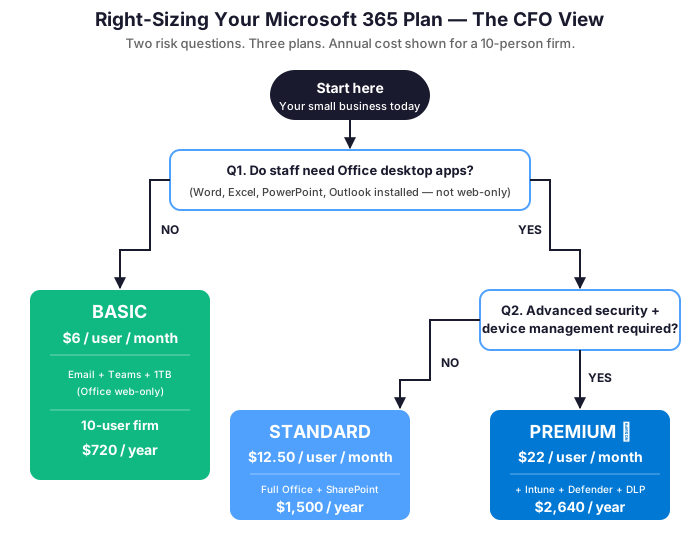
Not every business needs the most expensive plan. Not every employee needs the same features. Microsoft 365 offers three tiers: Business Basic, Business Standard, and Business Premium. The right choice depends on your security requirements. Plus the devices your team uses. And whether you need advanced compliance features. A 5-person creative agency has different needs than a 50-person law firm with client confidentiality requirements.
This is where a certified Microsoft partner pays for itself. Otherwise, choosing the wrong plan means paying for features you do not use. Or missing security capabilities your industry requires. Book a free call. We will map the right plan to your specific situation.
📈 OPEX vs CAPEX: Why CFOs Should Care About the Difference
Traditional IT infrastructure is a capital expenditure (CAPEX) — a server purchase that goes on the balance sheet, depreciates over five to seven years, and ties up capital that could otherwise fund hiring, inventory, or growth. In contrast, Microsoft 365 is an operating expenditure (OPEX) — a subscription that hits the P&L monthly, requires no depreciation schedule, and scales linearly with headcount. For businesses in growth mode, this distinction matters considerably. Moreover, OPEX does not consume the capital reserves that fund expansion, and it does not leave you holding depreciating infrastructure when your business model shifts.
⚖️ Why the SLA Matters on the Balance Sheet
Furthermore, the Service Level Agreement (SLA) Microsoft attaches to Microsoft 365 — 99.9% uptime, financially backed — eliminates a category of risk that on-premises infrastructure forces onto your balance sheet implicitly. When an on-premises server fails, the downtime cost falls entirely on your business. However, when Exchange Online experiences an outage (which happens, rarely), Microsoft’s SLA provides service credits. As a result, the risk transfer is real, even if it does not appear as a line item on your insurance schedule.

📚 More for Finance Leaders
Microsoft 365 for Architecture Firms: Build a Better Back Office
Not ready for a call yet?
See exactly what we audit before engaging. Download our free 50-point M365 Tenant Security Audit Checklist — the same framework we use on every client onboarding.