
For years, the advice to restaurant owners was simple. Lock down the card reader. You did. Chip terminals and encryption turned the checkout into the hardest part of your business to rob. As a result, attackers stopped trying there. In practice, a modern restaurant data breach almost never starts at the till.
Instead, it starts in the digital layer you bolted on to keep up. For example, think online ordering, delivery apps, the reservation system and the loyalty database. The good news is simple. You do not need a bigger budget to close these gaps. Specifically, you only need to know which systems hold customer data and who can reach them.
🍽 Not sure which of your systems hold guest data?
Wintive helps US restaurants and hospitality groups protect customer data across every connected system. Specifically, the work maps where data lives, tightens who can reach it, and gives you proof for your processor. Furthermore, it runs on the Microsoft 365 you already pay for, at a predictable monthly cost.
📅 Book a Free 30-Min Call | 💬 Chat on WhatsApp | See Our Plans →
This guide follows the breach as it truly happens in 2026. First, it shows where the attack really begins and what thieves are after. Then it covers the supplier risk, the real cost, and the practical fixes that need no new product.
🍽 Your restaurant data breach won’t start where you think
📌 TL;DR — a restaurant data breach in 2026 rarely starts at the card reader. Chip and encryption hardened payments. As a result, attackers shifted to online ordering, loyalty data and stolen logins. The fix is to map every system that holds guest data, lock it down, and prove it.
Why the card reader is no longer the weak point
EMV chip cards changed the maths for criminals. A terminal now encrypts card data the instant it reads it. Then it swaps that data for a useless token. As a result, skimming the till stops paying off. The classic in-store card-theft breach has faded. In short, the terminal became the safe part of your business.
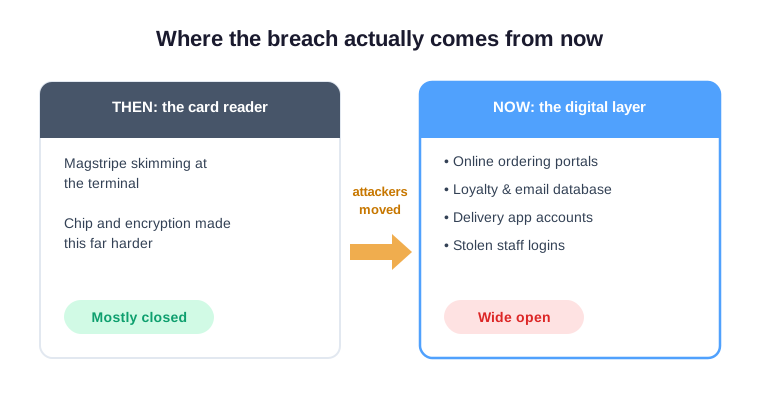
So the threat did not vanish. Instead, it moved. Attackers always follow the easiest data. Today, that data sits in the cloud systems around the kitchen. By contrast, it no longer sits on the chip in a guest’s card. Notably, that one shift explains almost every restaurant breach in the news today. Therefore your attention belongs on the cloud systems. The till is no longer the place to guard.
💻 You became a tech company and nobody told you
Think about how many systems your restaurant now runs. There is a cloud point-of-sale and an online-ordering site. Then come two or three delivery-app dashboards. Add a reservation platform, a loyalty tool, payroll and scheduling. Each one arrived to solve a real problem. However, each one also collects and stores customer or staff data.
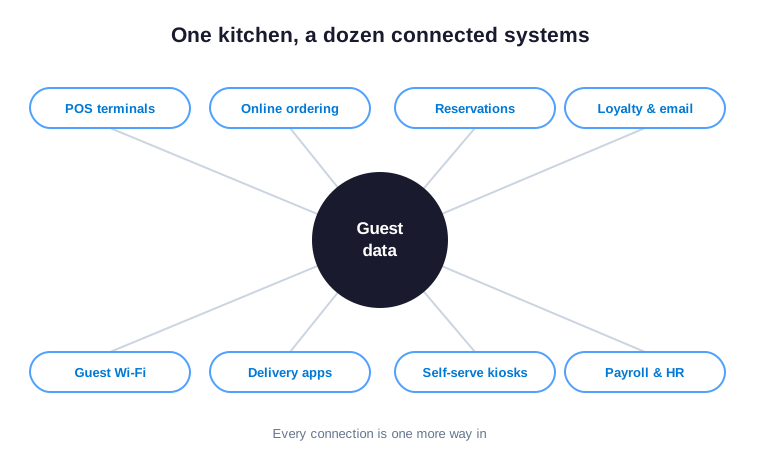
Every app you bolted on is a new door
Here is the uncomfortable part. You switched most of these tools on fast. The goal was simply to keep service moving. As a result, almost none went through a security review first. Each integration is a door into your data. Furthermore, you now have a dozen of them. In practice, every door has its own login and its own way to fail. Moreover, nobody owns all of those doors at once. So gaps open quietly, and nobody notices.
The systems rarely talk to each other
These tools came from different vendors at different times. As a result, they never share one clear view. No single person can say who reaches the customer list. Nobody is quite sure where card details actually sit. By contrast, a thief needs only one of those blind spots. Critically, that gap turns a small problem into a full breach. In short, that blind spot is the real risk. A thief simply walks through the gap you cannot see.
🎯 The real target is your guest list, not the card
When a restaurant is breached today, the prize is rarely a card number. Instead, thieves want your customer data. Research shows that nearly half of retail and hospitality breaches steal personal information. That means names, emails, phone numbers and order history. By contrast, a bank can cancel a card in minutes. Personal data never expires. As a result, your guest list is worth far more than one busy night of card sales.
How a restaurant data breach exposes your guest list
Your loyalty programme is quietly the richest file you own. It links a name to an email and a phone number. It also holds favourite orders and how often someone visits. Notably, security researchers call loyalty databases a hacker’s favourite target. The reason is simple. One stolen manager login can export tens of thousands of profiles in seconds. Furthermore, no alarm sounds and no window breaks. In short, the thief walks out with your whole relationship history. For a thief, that one file beats any single card. After all, it can be sold and reused for years.
They don’t break in, they sign in
The most surprising part is simple. Specifically, these thefts involve no hacking at all. Instead, attackers just sign in. They use a password that was phished, reused or bought cheaply. Moreover, Verizon’s 2025 research ties nearly three in four breaches to human error. In short, your weakest lock is not your software. It is a shared password that former staff still know. Notably, a second login factor stops most of these sign-ins. It costs only a few dollars per user.
🔗 A restaurant data breach often isn’t even your fault
Some of the worst incidents start with a company you never think about. Your online-ordering provider holds your guests’ data. So do your delivery partners and your payment processor. As a result, a breach at any one of them becomes your breach too. In 2025, vendor and supply-chain attacks were the second most common cause of data loss. Moreover, they ranked among the most expensive. After all, one supplier connects to thousands of businesses at once.
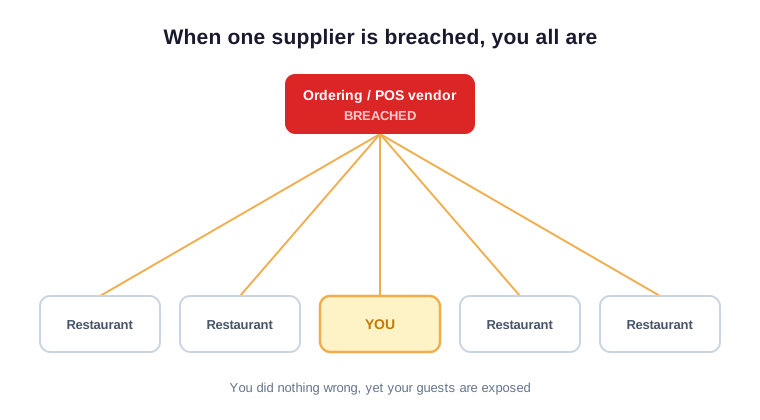
When a delivery or ordering partner gets hit
Early in 2025, a major food-ordering platform disclosed a breach. The incident hit one of its own outside suppliers. As a result, customer and driver data was exposed. The restaurants on that platform had done nothing wrong. However, their guests were swept up all the same. In short, when you plug into a big platform, you also inherit its security. By contrast, you rarely get a say in their defences. Therefore you must vet who you connect to.
The vendor key you forgot you handed out
The most famous retail breach in history began with a small contractor. That firm only handled heating and cooling. Critically, it still held a network login. Attackers used that one forgotten key to reach the payment systems. The lesson for any restaurant is direct. Specifically, every supplier you grant access to is a possible way in. Therefore you must know who holds a key and what it unlocks.
💸 What a restaurant data breach actually costs you
Owners often picture a breach as one fine and an awkward email. For a small restaurant, the real damage runs much deeper. Specifically, the headline cost is the smallest part of the bill. Underneath it sits a stack of hidden expenses. In practice, those costs can close a business already on thin margins. After all, a few bad weeks can wipe out a year of profit.
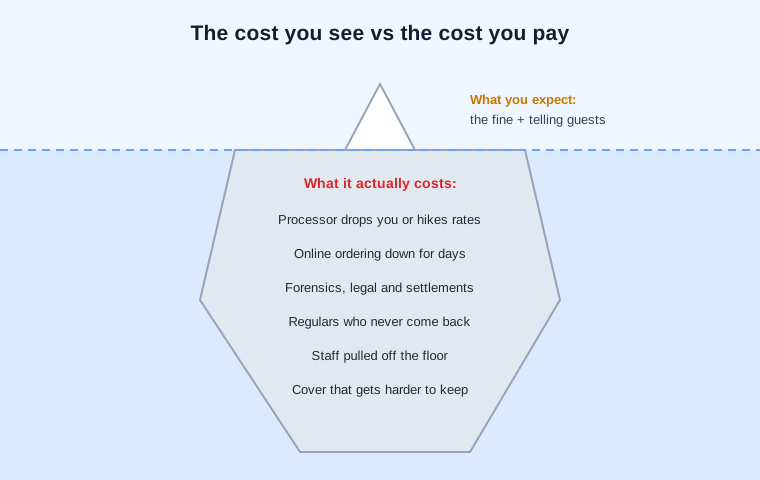
The part you can see is small. Specifically, it is a fine and a notice to guests. By contrast, the part that sinks restaurants hides below the waterline. Think lost card processing and days of downtime. Add forensic fees, legal fees and regulars who quietly stop coming. As a result, the real cost dwarfs the penalty itself.
| What it costs you | Why it hurts | How long it lasts |
|---|---|---|
| Lost card processing | Your processor can drop you or raise rates | Threatens every future sale |
| Online ordering offline | Ransomware can shut down digital orders | Days of lost revenue |
| Forensics and legal | Outside experts and lawyers must step in | Weeks of fees |
| Regulars who leave | Diners avoid a name they read about online | A season or more |
Why the bill outlives the headline
The news moves on within days. However, your costs do not. You may lose PCI good standing. Then your processor can raise your rates or drop you entirely. Meanwhile, ransomware can keep online ordering offline for days. In fact, that hit one well-known doughnut chain in late 2024. Add forensics, legal fees and lost regulars. As a result, one incident can shadow your accounts for a full year. In practice, the headline fades long before the costs do. That long tail is what closes small restaurants.
🧾 Everything you hold, and the rules that follow
Different data carries different obligations. Notably, a restaurant holds more sensitive data than most owners realise. You take a card. Then you store a phone number. You also keep an employee’s tax details. As a result, rules attach to each of those records. In practice, ignoring them turns a simple mistake into a regulatory problem.
| What you hold | The rule that applies | Why it matters |
|---|---|---|
| Card details | PCI DSS | Fines and lost card processing |
| Customer personal data | US state privacy laws | Regulator action and notice costs |
| Employee records | Privacy and HR rules | Liability for exposed staff data |
Card payments and the cost of PCI
Any restaurant that takes cards must meet the PCI DSS standard. Moreover, its latest version expects continuous protection and multi-factor logins. Smaller restaurants usually prove this with a self-assessment questionnaire. However, card details often sit in an inbox or a spreadsheet. In practice, that almost always breaks the rules. As a result, weak compliance pushes both your risk and your fees higher. Therefore keeping card data out of email pays for itself. It is also one of the simplest wins available.
Privacy law and your guests’ personal details
Names, emails, phone numbers and dining habits fall under US state privacy laws. In practice, regulators expect three things. You must know what you hold. You must protect it properly. Finally, you must delete it once you no longer need it. Notably, diners expect the same standard. In fact, nearly three in four worry about how restaurants handle their data. As a result, careful data hygiene is now a trust signal. Guests increasingly choose places they trust.
Loyalty profiles and employee records
Two files deserve special care. Your loyalty database is a marketing goldmine. However, it is also a privacy liability. Therefore you should keep only what you truly use. Your employee records hold tax identifiers and home addresses. In fact, a recent breach at a large restaurant group exposed exactly this staff data. As a result, both belong under lock and key, never in a shared folder.
👥 Turnover, shared logins and the ghost accounts left behind
Restaurants run on people. Moreover, people move on faster here than almost anywhere else. In practice, seasonal hires, students and quick exits are part of the trade. The real problem comes afterwards. A cook or manager leaves, but their login keeps working. As a result, you are left with a ghost account. In short, it is an open door with nobody behind it.

The five-minute habit that closes ghost accounts
The fix is not complicated. However, it has to be consistent. The moment someone leaves, their access ends the same day. Furthermore, shared passwords give way to individual logins you can switch off one by one. The same habit covers people who change roles. This mirrors the routine that protects a hotel’s guest records. In practice, it removes one of the most common breach causes for good. Furthermore, it takes only a moment on a final shift. So there is no real excuse to skip it.
🔍 What a restaurant data breach audit reveals
An audit is not a sales pitch or a pile of jargon. Instead, it is a clear, plain-English picture of where you stand. It maps every place customer and card data lives. Furthermore, it shows who can reach each system today. It also flags where you fall short of the rules. As a result, you finally see the whole stack in one view. For the first time, the whole picture fits on one page. Then you can decide what to fix first.
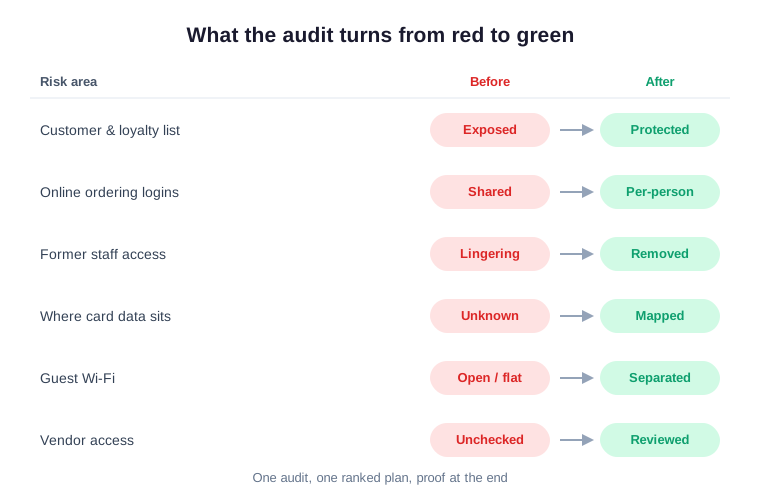
The real value lives in the before-and-after. Specifically, a wall of red unknowns becomes a short, ranked list. Each fix turns green and carries a plain business reason. As a result, you spend on what truly lowers your risk. By contrast, you skip the rest with confidence.
Across the 60+ tenants we manage, we see the same common mistake in food service every time. A customer list nobody owns. Shared logins half the team knows. Card details lingering in an old inbox. It works fine every service, so the gap silently fails to raise a flag. Then someone signs in with a borrowed password. Notably, the same controls that fix this map straight to the PCI, SOC 2 and NIST language your processor already speaks. Therefore the audit does more than find gaps. It gives you proof, and proof is what keeps you trading.
What a restaurant data breach audit checks first
The first stop is always the customer list. Specifically, the audit asks who can export it. After all, that is the data thieves want most. From there, it reviews online-ordering and delivery logins. Furthermore, it checks any card details sitting in the wrong place. It covers former-staff access, the guest Wi-Fi and vendor keys. As a result, each item becomes a clear yes or no you can act on.
💵 The math: a quarter of work vs a closure
Every spending decision comes down to a comparison. So set the two paths side by side. On one side sits a focused audit and a few fixes, paid once. On the other sits the full cost of a breach. Think lost processing, downtime, fees and customers who never return. By contrast, those two numbers are not close. As a result, seeing them together makes the choice obvious.
| Your choice | What you spend | What you get |
|---|---|---|
| A focused audit and fixes | A fraction of one incident, paid once | Mapped data, locked access, proof |
| Doing nothing | The full breach bill if it lands | Closure-level risk on thin margins |
The gap is not subtle. One path costs a known, modest amount. Moreover, it lowers your risk for good. By contrast, the other is a wager against numbers that have closed restaurants. In short, you pay it only when it is far too late to prevent.
What good looks like in 2026
Strong protection in 2026 leans on what you already own. Specifically, Microsoft 365 Business Premium bundles secure sign-in, device management and data protection. It comes at one per-user, per-month price. Moreover, even Business Standard covers the basics. As a result, most restaurants never need a separate sign-in service such as Okta or Duo.
This matters for the budget as much as the risk. Specifically, leaning on one bundle lowers your total cost of ownership, or TCO. Furthermore, it shifts spending from a large CapEx outlay to a steady, predictable OpEx line. The same discipline protects a healthcare practice or a financial services firm. In practice, it protects a restaurant just as well. Notably, the controls line up with standards from the PCI Security Standards Council. After all, that is the language your processor wants to hear. In short, you protect the business and the budget together. That is the outcome every owner wants.
🗺 Your 90-day restaurant data breach prevention plan
You do not have to fix everything at once. In practice, a simple three-step plan works over one quarter. It takes a restaurant from exposed to protected. Moreover, it never disrupts a single service. Specifically, each phase delivers something concrete. You can show it to your team, your processor and your insurer.
| Phase | What you do | What you get |
|---|---|---|
| Days 1 to 30: Find | Map where customer and card data lives | A clear picture and ranked gaps |
| Days 31 to 60: Fix | Lock down access and close ghost logins | A far smaller, tighter target |
| Days 61 to 90: Prove | Turn on monitoring and document controls | Proof for your processor and insurer |
By the end of the quarter, you are not merely safer. As a result, you can prove it. That protects your card processing, your insurance and your reputation. Furthermore, the routine then runs quietly in the background. In short, you stay protected without constant effort or cost.
That is the real prize. It is not a frantic scramble after the worst happens. By contrast, it is a calm, repeatable standard. So start with the question you could not answer at the top. Then let an audit turn it into a short, fundable plan.
📚 More for US hospitality teams
🍽 Protect your guest list before a breach finds it
It is a full Microsoft 365 audit for a US restaurant or hospitality group. Specifically, it maps where customer and card data lives. Furthermore, it locks down access, closes former-staff logins, and reviews your delivery vendors. As a result, you get a written report with prioritized fixes and proof. Moreover, it includes 14 days of email Q&A.
❓ Restaurant data breach: frequently asked questions
These are the questions US restaurant owners ask us most. Specifically, they come from real audits and processor reviews.
Common restaurant data breach questions
It is any unauthorised access to the customer, payment or staff data you hold. Today it usually means stolen logins exposing your loyalty list or online-ordering accounts, not card theft at the terminal.
Most start in the digital layer around the till. Think online ordering, delivery apps, loyalty databases and shared staff logins. Chip cards made the reader itself the hardest part to attack.
Far more than the fine. The lasting costs are lost card processing, downtime, legal fees and regulars who never return. Average hospitality breaches run into the millions.
Map every system that holds customer data. Lock down who can reach it. Turn on multi-factor logins and close former-staff access fast. Most of this runs on the Microsoft 365 you already own.
Yes. Small restaurants are targeted precisely because their defences are thin. One breach can end card processing and trust overnight. A short audit costs a fraction of that.