
When someone leaves your team, you have a routine. You collect the uniform. You take back the locker key and the name badge. Then you wave them off. But almost nobody switches off the logins. So weak hospitality staff offboarding turns a quiet goodbye into your next breach.
The person who left rarely means any harm. The real danger is the access that quietly stays behind. As a result, offboarding is your single most important security control. However, most teams treat it as paperwork. The good news is simple. You can run it well with the Microsoft 365 you already pay for.
🔑 Not sure who can still log in after they leave?
Wintive helps US hotels, restaurants and hospitality groups lock down access when people leave. Specifically, it maps every account a leaver can reach. Furthermore, it sets up same-day revocation and kills shared logins. As a result, you get proof for your processor and insurer, at a predictable monthly cost.
📅 Book a Free 30-Min Call | 💬 Chat on WhatsApp | See Our Plans →
This guide treats every departure as a security event. First, it shows what you forget to switch off. Then it covers who can still reach your guest data. Finally, it gives you a five-minute checklist that closes the gap for good.
🔑 Your biggest hospitality staff offboarding risk already quit
📌 TL;DR — weak hospitality staff offboarding leaves logins, email and apps live after people go. The threat is rarely malice. Instead, it is lingering access and shared passwords. The fix is a same-day checklist that revokes every account, run on the Microsoft 365 you already own.
Why the person who left is still inside
This industry runs on a revolving door of people. Seasonal hires, students and quick exits are normal. However, their access rarely leaves when they do. As a result, a former worker can still open your systems weeks later. In practice, that quiet login is your real breach risk. The contract ends on paper. The access does not. As a result, the working relationship is over, yet the door stays open. Notably, that open door is invisible from the floor.
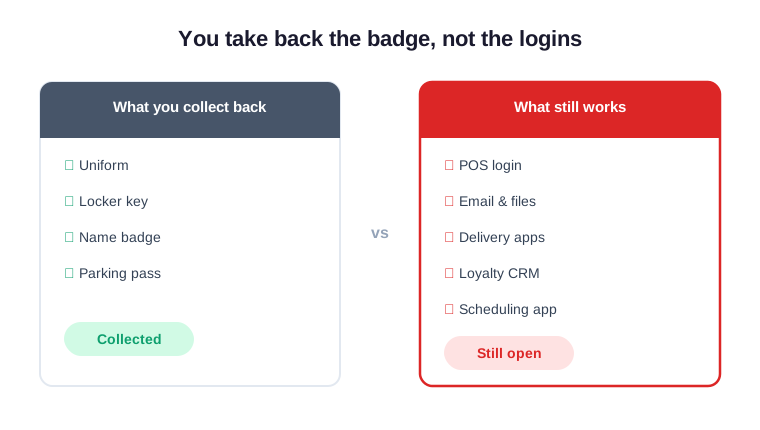
Think about what you actually reclaim on a last day. You take back the uniform, the badge and the keys. By contrast, the digital access stays live. Notably, that access is the part that reaches your guest data. So the badge in your hand proves very little. The live login is what counts. As a result, strong hospitality staff offboarding starts with the accounts, not the locker. In practice, that shift in focus changes everything.
🚪 You collect the keys but not the logins
Physical offboarding is a habit. Digital offboarding is an afterthought. Yet the digital side is where your data sits. As a result, the gap between the two is where breaches begin. In practice, nobody owns that gap, so it stays wide open. Someone always collects the keys. Meanwhile, no one disables the logins. Therefore the digital door stays unlocked. As a result, the gap survives every shift change.
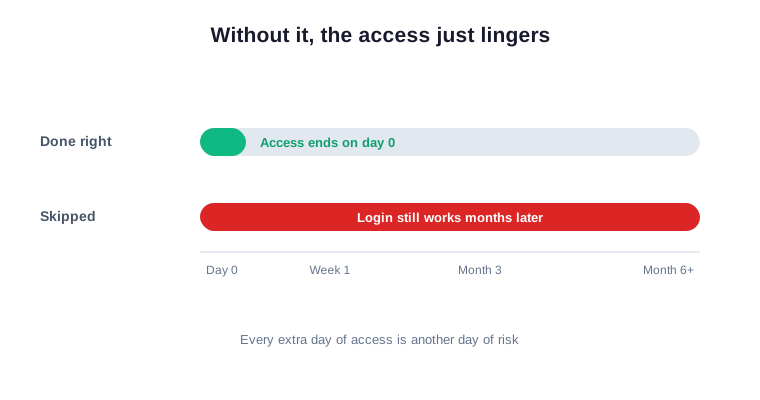
Why the uniform comes back but the password does not
A uniform is physical, so its absence is obvious. A login is invisible, so nobody misses it. As a result, the badge comes back on the last day. By contrast, the password lives on for months. Furthermore, a busy manager rarely has time to chase it down.
The accounts that outlive the contract
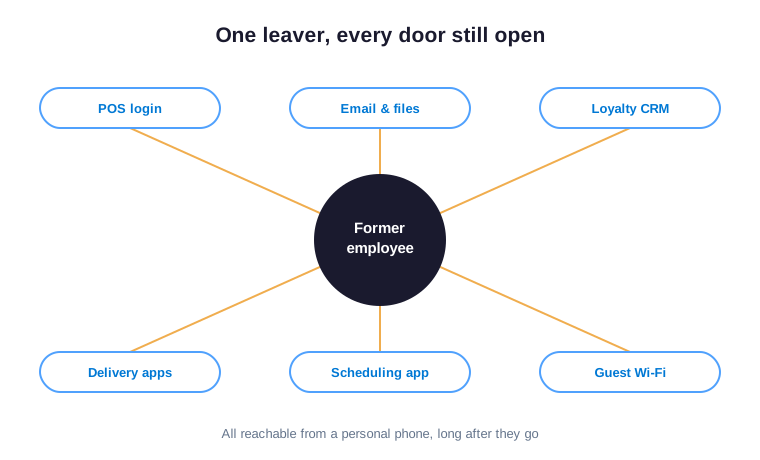
Picture everything a single worker touches. There is the point-of-sale login and the email account. Then come the delivery apps and the loyalty system. Add the scheduling tool and the shared Wi-Fi password. In practice, every one of these can outlive the contract by months. Each one is a separate login. Each one needs its own switch-off. However, most teams track none of them in one place. As a result, a single missed account is enough to leave you exposed for months.
🎯 The leaver who still reaches your guest list
Here is what makes this so dangerous. The access that lingers reaches your most valuable data. Specifically, it reaches your guest list: names, emails, phone numbers and order history. That list is exactly what thieves want most today. By contrast, the card itself is now well protected by chips and encryption. Therefore a former worker with a live login is a direct line to your guests. And that line stays open until someone finally closes it. Most owners never picture it this way. They guard the safe and the till closely. By contrast, the real treasure sits in a database. Anyone with a login can open it. Notably, that login often belongs to someone who left.
So picture the reach of one forgotten account. A single login can touch far more than the till. Specifically, it can open email, delivery apps, the loyalty system and scheduling. As a result, hospitality staff offboarding has to cover every one of them, not just the obvious ones.
How hospitality staff offboarding protects your guest list
Good offboarding draws a clear line around that list. The moment a worker leaves, their path to the data closes. As a result, the guest list stays only with people who still work for you. This mirrors the discipline that protects a hotel’s guest records and a restaurant’s customer data. In practice, it is the cheapest guest-list insurance you can buy. Furthermore, it takes minutes, not money. Think of hospitality staff offboarding as a fence around the guest list. The fence goes up the moment someone leaves. As a result, the data stays with your current team only. In practice, that beats cleaning up a breach.
They don’t break in, they sign in
Most of these incidents involve no hacking at all. Instead, someone signs in with a login that should be dead. Notably, Verizon’s 2025 research ties nearly three in four breaches to human error. In short, a live account is an open invitation. Furthermore, the attacker need not even be the person who left. A reused or leaked password works just as well. This is the quiet pattern behind most incidents. No alarm sounds. No lock breaks. Instead, a valid login does what it was always allowed to do. As a result, the breach looks like business as usual.
🔑 Shared passwords are a door you never close
Shared logins make the whole problem far worse. One manager password gets passed around the team. As a result, nobody knows who actually holds it. Worse still, it rarely changes when someone leaves. In practice, a single shared password can be known by dozens of former workers. So the door never really closes. Worse still, you cannot tell who used it. The login looks identical for everyone. As a result, accountability vanishes the moment a password is shared. In practice, that makes any investigation far harder.
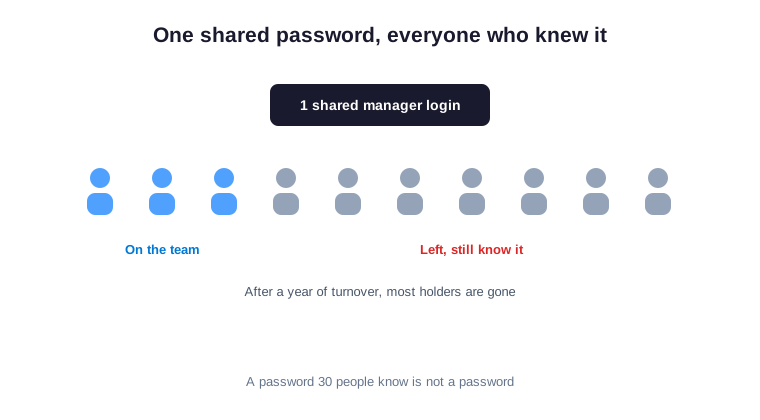
The math of a password thirty people know
Run the numbers for a single year. You might cycle thirty people through one role. Each one learns the shared password. However, only a handful still work for you by December. As a result, that password is effectively public. Critically, a secret known by thirty people protects nothing at all. Individual logins fix this at the root. Each worker gets a personal account. So one departure means one quick switch-off. By contrast, a shared password forces a reset for the whole team. As a result, individual logins save time and risk together.
💸 What weak hospitality staff offboarding costs you
A lingering login feels harmless until it is not. When a former worker’s access is abused, the bill arrives fast. Specifically, you face the same costs as any data breach. Think lost card processing, downtime and legal fees. By contrast, the trigger here is mundane: an account nobody closed. As a result, the cause is embarrassing and the cost is very real. No operator wants that call with a processor. Yet weak hospitality staff offboarding makes it likely. Specifically, it leaves a forgotten account as the easy way in. In practice, that is a wound you inflict on yourself.
| What it costs you | Why it hurts | How long it lasts |
|---|---|---|
| Lost card processing | A breach can cost your PCI standing | Threatens every sale |
| Forensics and legal | You must prove what was reached | Weeks of fees |
| Regulator notice | Exposed guest data triggers reporting | Fines and admin |
| Lost trust | Guests and staff hear about it | A season or more |
Why the bill outlives the goodbye
The departure is forgotten in a week. The breach it caused is not. As a result, you may lose card processing or face a regulator notice. Meanwhile, forensic and legal fees pile up quickly. Furthermore, guests who hear about it simply stop coming. In practice, one unclosed account can shadow your books for a full year. This is why hospitality staff offboarding belongs in your risk plan. It is far cheaper than any fine. Furthermore, it is cheaper than lost trade and lost trust. In short, prevention always beats the cleanup.
🧾 Everything a leaver could still touch, and the rules
A departing worker often touched more regulated data than you think. Specifically, they handled card details, guest records and their own HR file. Each of those carries its own rules. As a result, an unclosed account is not just a security risk. It is a compliance problem waiting to surface.
| What they could reach | The rule that applies | Why it matters |
|---|---|---|
| Card data | PCI DSS | Fines and lost processing |
| Guest personal data | US state privacy laws | Regulator action and notices |
| Employee records | Privacy and HR rules | Liability for exposed staff data |
Card data and the cost of PCI
PCI DSS expects you to control who can reach card data. Notably, its latest version now requires multi-factor logins and continuous checks. A former worker with access breaks that rule outright. As a result, weak control raises both your risk and your fees. In practice, clean offboarding is part of staying compliant. The link is direct and simple. Fewer open accounts means fewer paths to card data. Therefore tighter departures lower both your risk and your fees. As a result, compliance and savings point the same way.
Privacy law and personal details
Guest names, emails and numbers fall under US state privacy laws. In practice, regulators expect you to limit who can reach them. A live former login fails that test. By contrast, same-day revocation passes it cleanly. Furthermore, it shows regulators that you took reasonable care.
👁 When access lingers, nobody notices
A live former login is almost invisible. It is a valid account, so it raises no alarm. As a result, abuse looks exactly like normal use. By contrast, a stolen card sets off fraud checks within hours. In practice, an unclosed account can sit quiet for months before anyone spots it. That silence is exactly the danger. A loud attack gets a fast response. By contrast, a quiet login gets ignored. As a result, the damage is often done long before anyone looks.

The five-minute habit at every departure
The fix is a short, fixed routine. Right when a worker leaves, you run one checklist. Specifically, you disable their main login, email and app access the same day. Furthermore, you swap any shared password they knew. The same habit covers anyone who changes role. In practice, five minutes per departure closes the gap for good. Build the habit once and it runs itself. Specifically, the same steps apply to every single leaver. As a result, hospitality staff offboarding stops being a scramble. Instead, it becomes a quiet routine nobody has to think about.
🔍 What a hospitality staff offboarding audit reveals
An audit turns guesswork into a clear picture. It lists every account each person can reach. Furthermore, it flags shared logins and stale access. It also shows where you fall short of the rules. As a result, you see the whole picture in one place, instead of hoping nothing was missed.
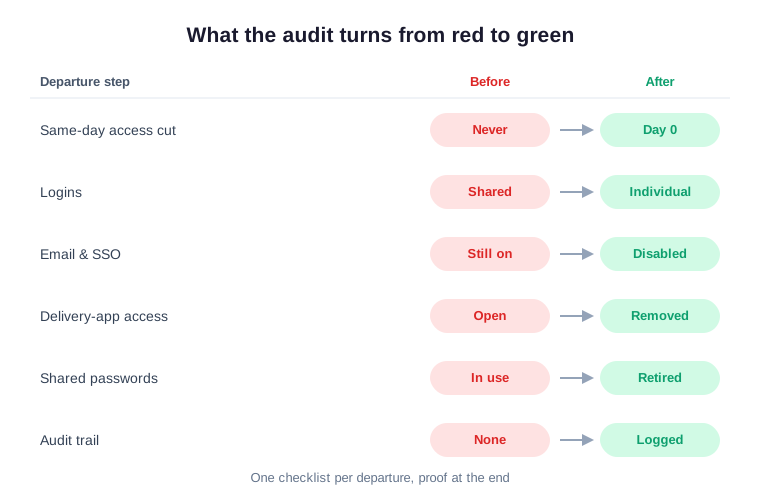
The value is in the before-and-after. Specifically, a list of red unknowns becomes a short, ranked plan. Each item turns green with a clear owner. As a result, you fix what truly matters first and prove the rest is done. Notably, that order is what makes the work fast. Furthermore, it keeps every decision easy to defend later.
Across the 60+ tenants we manage, we see the same common mistake in hospitality every time. Nobody owns the leaver checklist. Shared logins drift for months. Old accounts silently fail to get switched off. It all works fine until one former login is abused. Notably, the controls that fix this map straight to the PCI, SOC 2 and NIST language your processor and insurer already speak. Therefore the audit does more than find gaps. It hands you proof, and proof is what keeps you trading.
What a hospitality staff offboarding audit checks first
The first question is always simple. Who can still reach the guest list and the card data? From there, the review covers shared logins and former-staff access. It checks email, delivery apps, the loyalty system and scheduling. As a result, each one becomes a clear yes or no you can act on this week. No guesswork remains after that. Each account is either open or closed. Furthermore, each gap comes with a named owner and a due date. As a result, the list turns straight into action.
💵 The math: minutes per leaver vs a closure
Set the two options side by side. One is a five-minute checklist at each departure. The other is the full cost of a breach you could have prevented. As a result, the comparison is not close. By contrast, the cheap option is also the one that protects you. In practice, the choice makes itself.
| Your choice | What it takes | What you get |
|---|---|---|
| Run the checklist | Five minutes per departure | Closed access and a clear trail |
| Skip it | Nothing, until a breach lands | Closure-level risk and fees |
The gap could not be wider. One path costs minutes and a little discipline. By contrast, the other risks your processing, your licence to trade and your name. In short, you pay it only when it is far too late.
What good looks like in 2026
Strong control in 2026 uses what you already own. Specifically, Microsoft 365 Business Premium handles secure sign-in and one-click account disabling. It comes at one per-user, per-month price. Moreover, even Business Standard covers the basics. As a result, most teams never need a separate identity tool such as Okta or Duo.
This helps the budget as much as the risk. Specifically, one bundle lowers your total cost of ownership, or TCO. Furthermore, it keeps spending as steady, predictable OpEx rather than a large CapEx outlay. The same approach protects a healthcare practice or a financial services firm. In practice, it protects a hotel or restaurant just as well. Notably, the controls line up with the PCI Security Standards Council. After all, that is the language your processor wants. Done this way, hospitality staff offboarding pays for itself. It lowers risk and steadies cost at once. In short, good control is also good budgeting. As a result, the case for it writes itself.
🗺 Your 90-day hospitality staff offboarding plan
You do not need to fix everything at once. In practice, a simple plan over one quarter does the job. It turns a messy process into a clean, repeatable routine. Moreover, it never disrupts a shift. Specifically, each phase gives you something concrete to show.
| Phase | What you do | What you get |
|---|---|---|
| Days 1 to 30: Find | List who can reach each system | A clear map and ranked gaps |
| Days 31 to 60: Fix | Add same-day revocation and individual logins | A far smaller target |
| Days 61 to 90: Prove | Turn on logging and write the checklist | Proof for processor and insurer |
By the end of the quarter, every departure is handled the same way. As a result, you can prove access ends when employment does. Furthermore, the routine runs in the background from then on. In short, you stay protected without extra effort or cost.
That is the real win. It is not a scramble after a former login is abused. By contrast, it is a calm, repeatable standard. So start with the question from the top of this guide. Then let an audit turn it into a short, fundable plan. Strong hospitality staff offboarding is within reach for any US operator. It needs minutes, not a big budget. Furthermore, it protects the very data your guests trust you with. So the question is simple. Will the access leave when the worker does?
📚 More for US hotels and restaurants
🔒 Close the door before a former login does the damage
It is a full Microsoft 365 audit for a US hotel, restaurant or hospitality group. Specifically, it maps every account a departing worker can reach. Furthermore, it sets same-day revocation, kills shared logins, and turns on the logs that prove it. As a result, you get a written report with ranked fixes and proof, plus 14 days of email Q&A.
❓ Hospitality staff offboarding: frequently asked questions
These are the questions US hospitality owners and operators ask us most about departures and access.
Common hospitality staff offboarding questions
It is removing a worker access when they leave or change role. That means disabling logins, email and apps, and retiring shared passwords, so former staff cannot reach your data.
Turnover is high, and access often lingers after people go. A former login can still reach your guest list and card data. As a result, it becomes an easy, quiet way in.
Disable the main login, email and app access the same day. Then remove delivery, loyalty and scheduling access. Finally, change any shared password the person knew.
Yes. Microsoft 365 lets you disable an account and all its access in one place. Business Premium also adds secure sign-in and device control, so most teams need nothing extra.
The same day, ideally the same hour. The longer an account stays live, the longer your data is exposed. In practice, same-day revocation is the simplest safe rule.