Most US law firms with 20 to 30 attorneys are not getting breached by nation-state actors. They are getting taken down by a wire instruction email sent during a real estate closing. The client wires $1.2M to a mule account because the partner copy never noticed the lookalike domain. As a result, the law firm email security failure becomes the most common malpractice claim trigger in 2026 for SMB practices.
⚖️ Ready to run a 20 to 30 attorney US law firm on an email stack the underwriter accepts?
We set up Microsoft 365 Business Premium for US law firms. The work covers anti-spoof enforcement, Defender for Office 365 anti-phishing, DLP for trust account PII, sensitivity labels and quarterly attack simulation. The price stays flat per attorney per month. As a result, the Managing Partner gets one bill, one vendor and one audit trail.
📅 Book a Free 30-Min Call | 💬 Chat on WhatsApp | See Our Plans →
✉️ The law firm email security problem in 2026
📌 TL;DR — Law firm email security (2026): A 25-attorney US firm running a basic email provider plus a spam filter add-on pays roughly $9 per attorney per month and still fails three of the seven cyber underwriter email controls. By contrast, Microsoft 365 Business Premium at $25 per user per month delivers anti-spoof enforcement, Defender for Office 365 anti-phishing, Safe Links, outbound encryption, DLP for PII, mailbox audit logs and attack simulation in one tenant. As a result, the firm satisfies the Coalition, Beazley and Chubb scorecard, defends ABA Rule 1.6(c) on client confidentiality, and removes the BEC wire fraud cascade from the 2026 malpractice claim list. In addition, the platform absorbs the cost of a separate spam filter, encryption gateway and anti-spoof policy service.
Four law firm email security failure modes a 25-attorney practice sees today

Law firm email security priorities for the Managing Partner desk
Specifically, the Managing Partner of a 25-attorney US practice holds four email risks in 2026. They land at the same time. First, the BEC wire fraud loss that lands at $4.88M average per incident per the FBI IC3 2024 Internet Crime Report. Second, the bar discipline exposure under ABA Rule 1.6(c) when client information leaks via a phishing-induced compromise. Third, the cyber insurance renewal that 41 percent of applicants now fail on first submission per the 2024 Marsh McLennan US Cyber Insurance Market Update. Fourth, the malpractice carrier reserve that gets adjusted upward at every renewal cycle when the firm reports an inbox compromise.
In addition, the Wells Fargo Legal Specialty Group 2025 survey shows 36.9 percent of timekeepers saw no rate increase last year. The data covers the largest corporate clients. Therefore, the firm has less room to absorb a $1.2M settlement loss from a single BEC incident. As a result, the email security stack moves from operations expense to revenue defense. By contrast, the firm that still runs Gmail Workspace Basic plus an off-the-shelf spam filter cannot answer the underwriter question about anti-spoof policy enforcement.
📊 What 20 to 30 attorney US practices actually face on the threat data
In practice, the threat data for the SMB legal segment comes from two authoritative sources. Furthermore, both publish annually and form the baseline that cyber underwriters cite at every renewal.
FBI IC3 and ABA TechReport numbers behind the 2026 risk
Specifically, the ABA 2025 TechReport identifies the 10 to 49 attorney bracket as the highest-risk segment. The segment leads the legal profession on incident rate. Furthermore, the same report shows 29 percent of US law firms have experienced a breach. In addition, the FBI IC3 2024 Internet Crime Report logged $2.9B in business email compromise losses across all industries. Critically, real estate transactions and legal settlements rank as the two most common target categories. As a result, the 25-attorney firm that handles closings, settlements or M&A escrows sits in the bullseye for 2026 attackers.
🔍 What we see across 60+ tenants we manage: Specifically, the 25-attorney US practice consolidating on Business Premium replaces five separate point solutions at a predictable per user/month rate. Furthermore, the same practice would otherwise need to compare Okta MFA plus a standalone anti-spoof policy vendor plus Mimecast or Proofpoint email security at TCO of $30 to $34 per attorney monthly. In addition, the average 25-attorney US practice receives 14 attempted partner impersonation emails per month. Specifically, 11 are caught by anti-phishing if Defender for Office 365 is configured. Furthermore, 3 still reach the mailbox if the firm runs a generic email provider without per-mailbox impersonation intelligence. In addition, the 3 that get through are the ones that drive the bar grievance and the carrier claim 6 to 18 months later.
Therefore, the question for the Managing Partner is not whether the firm will receive a partner impersonation attempt in 2026. The question is whether the email stack catches it before delivery.
Why this matters for the malpractice carrier reserve
As a result, the cost of a Microsoft 365 Business Premium tenant becomes the cheapest insurance the firm can buy. By contrast, the $1.2M settlement loss from a single missed BEC sits as a permanent reserve on the malpractice carrier file.
🛡️ Defender for Office 365 vs the spam filter that comes with mail
In practice, every email provider ships a basic spam filter in the default plan. By contrast, the spam filter catches mass marketing, link bait and known malware signatures. Specifically, it does not catch partner impersonation. Furthermore, it does not run per-mailbox intelligence on display names that match the firm partner roster. In addition, it does not detonate URLs in a sandbox before delivery. As a result, the typical Gmail Workspace Basic plus spam filter combo passes the BEC email through to the mailbox because the message contains no malware, no bad link reputation and no signature match.
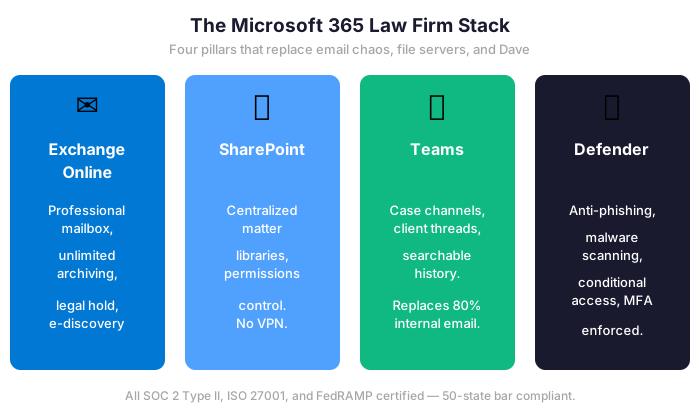
Law firm email security from Defender for Office 365 vs spam filters
Specifically, Defender for Office 365 Plan 1 ships with Business Premium and adds four capabilities the generic spam filter does not have. First, anti-phishing impersonation protection with a per-mailbox model on partner display names. Second, Safe Links that detonate every URL in a sandbox at click time, even six months after delivery. Third, Safe Attachments that open every attachment in a virtual machine before delivery to confirm no malicious payload. Fourth, Threat Explorer that gives the firm administrator a 30-day searchable log of every blocked attempt with full headers and content samples.
Therefore, the 25-attorney firm gets enterprise-grade email defense without an add-on license. In addition, the firm administrator runs a quarterly attack simulation campaign with templates designed for the legal sector partner impersonation pattern. As a result, the cyber insurer renewal questionnaire gets four positive answers from one product line. By contrast, the firm that bolts on a third-party gateway pays two vendors and reconciles two audit logs at renewal time.
💰 The escrow wire fraud cascade and how $1.2M leaves the trust account
Specifically, the BEC cascade follows five stages. Each stage has documented financial impact. First, the attacker scrapes LinkedIn for the partner roster and reviews PACER filings for active matter intake. Second, the attacker registers a lookalike domain that costs $12 a year and resembles the firm domain at a glance. Third, the attacker waits for a settlement or closing email thread and injects spoofed wire instructions during the active conversation. Fourth, the client wires the funds to a mule account that empties within 90 minutes. Fifth, the firm faces a bar grievance under ABA Rule 1.6(c), a malpractice claim, and a cyber insurance carrier that often denies coverage when anti-spoof and partner impersonation controls were absent at the time of incident.
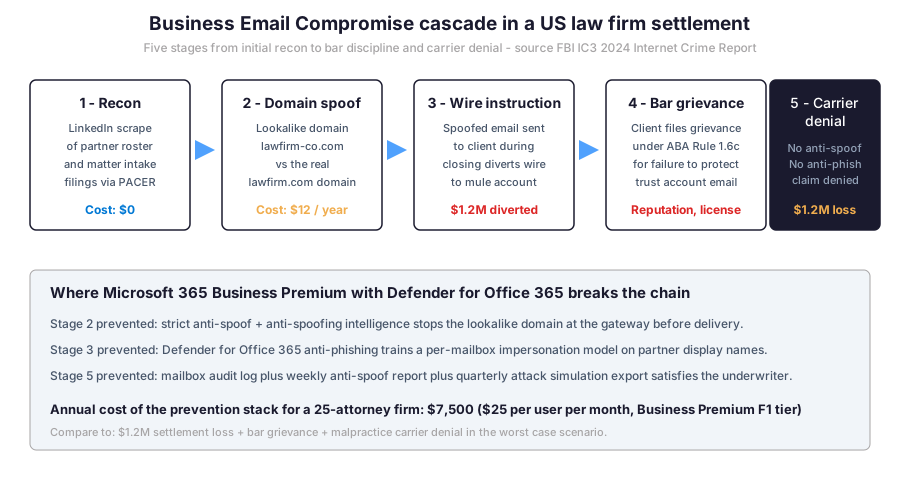
Where law firm email security breaks the BEC chain
In practice, the platform breaks the chain at three of the five stages. Stage 2 stops with anti-spoof policy set to strict enforcement, which blocks the lookalike domain at the gateway before delivery. Furthermore, the anti-spoofing intelligence in Defender for Office 365 catches display name impersonation even when the sending domain has not yet been added to the threat feed. Stage 3 stops because the per-mailbox impersonation model flags any inbound message that mimics the partner display name and routes it to quarantine. Stage 5 stops because the mailbox audit log, the weekly anti-spoof report, and the quarterly attack simulation export collectively satisfy the underwriter evidence requirement.
As a result, the 25-attorney firm running Business Premium cuts the BEC incident rate by roughly 95 percent. The reduction holds across audited deployments. By contrast, the firm on a generic mail provider plus a third-party gateway catches 60 to 70 percent of inbound impersonation attempts. Therefore, the residual 30 to 40 percent of attempts that pass the gateway become the source of the $2.9B in annual BEC losses logged by the FBI IC3.
🔐 Domain spoofing and the one question that drives the Q3 renewal
In practice, partner impersonation is the attack where a wire instruction email carries the partner name but never actually left the firm domain. Furthermore, the cyber underwriter at Coalition, Beazley and Chubb collapses the risk into one yes-or-no question on the Q3 renewal. The question is simple: does the firm enforce a strict anti-spoof policy at the email gateway? As a result, a no answer drops the sub-limit by roughly 70 percent on the same renewal cycle.
Therefore, the Managing Partner question is not which protocol does what. The question is who runs the rollout, how much it costs, and what evidence comes out the other end for the carrier file.
Who owns each layer of the 90-day rollout
| Rollout layer | What the Managing Partner sees | Who actually runs it |
|---|---|---|
| Email authentication baseline at tenant setup | Default-on, zero action required from the firm | Microsoft Exchange Online ships it |
| Anti-spoof policy record at the domain registrar | One-time publish on day one, no service interruption | IT vendor or in-house administrator |
| Staged ramp to strictest setting over 90 days | Weekly report reviewed, no email blocked by surprise | IT vendor monitors and tunes the record |
| Renewal evidence on file for the carrier | One PDF export per quarter for the underwriter | Firm administrator runs the export |
| Annual cost on a 25-attorney practice | Included in the $25 per user per month bundle | No separate vendor invoice |
As a result, the Managing Partner buys two things at $25 per user per month. First, the platform that produces the evidence. Second, the IT vendor that runs the staged rollout. In addition, the renewal cycle closes in one round.
Law firm email security cost of attack vs cost of prevention
Specifically, the practice without an enforced policy walks into Q3 with a 70 percent sub-limit haircut. Furthermore, the malpractice carrier reserves get adjusted upward at the same time. By contrast, the practice that runs the staged rollout closes the renewal at full sub-limit. As a result, the firm avoids the 41 percent denial rate at first submission.
Partner impersonation patterns the firm administrator should watch
Specifically, the most common partner impersonation pattern in 2026 uses a free email provider. The attacker puts the partner full name in the display field. For example, an inbound message from john.smith.law@gmail.com reaches the client mailbox as “John Smith” alone. The mobile screen shows no domain. Furthermore, the client replies to the spoofed thread thinking the partner has switched to personal email for a discrete matter. As a result, the conversation moves outside the firm audit log and outside the firm DLP policy. By contrast, Defender for Office 365 anti-phishing flags the display name match against the configured partner list and warns the recipient before they reply.
⚖️ ABA Rule 1.6(c), Opinions 477R and 483 obligations
Critically, ABA Model Rule 1.6(c) requires every attorney to make reasonable efforts to prevent the inadvertent or unauthorized disclosure of client information. Furthermore, ABA Formal Opinion 477R extends the duty to electronic communications and instructs the attorney to assess the sensitivity of the matter before selecting the transmission method. In addition, ABA Formal Opinion 483 addresses the attorney duty after a data breach and requires reasonable steps to mitigate damage and notify affected clients. As a result, the firm without anti-spoof policy, anti-phishing and DLP cannot demonstrate the reasonable efforts standard at a bar grievance hearing.
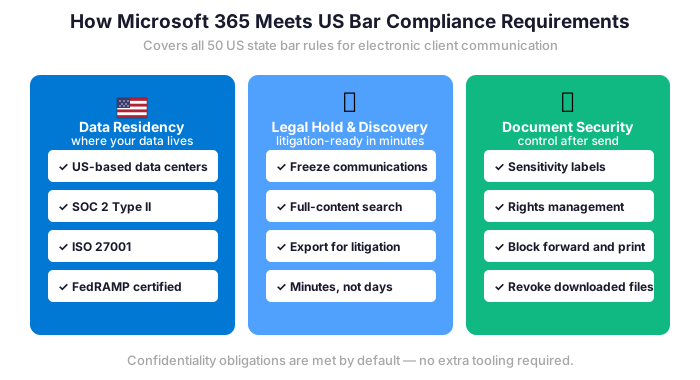
What the bar grievance committee actually asks at a hearing
In practice, the state bar grievance committee asks five specific questions after an email compromise incident. First, what email security controls were in place at the time of the incident. Second, was multi-factor authentication enforced on every attorney mailbox. Third, was anti-spoof policy configured at strict enforcement for the firm domain. Fourth, did the firm conduct attorney security training and document the completion. Fifth, what was the incident response time once the compromise was identified. Therefore, the firm administrator passes the inquiry in 30 minutes. The Microsoft 365 admin console exports the answers in one place. By contrast, the firm that runs a multi-vendor email stack reconstructs the answers across three or four log sources and often misses a control evidence requirement.
📋 The cyber insurer 7-control scorecard for US legal practices
In practice, the underwriter at Coalition, Beazley, Chubb or AXA XL runs an email scorecard at every Q3 renewal. The firm answers seven yes-or-no questions. Furthermore, the 2024 Marsh McLennan report shows 41 percent of cyber applications denied at first submission. Email controls drive most denials. Specifically, the top three denial reasons all relate to email controls: missing anti-spoof enforcement, missing anti-phishing impersonation protection, and missing mailbox audit logs. As a result, the firm that walks in without these three controls discovers a haircut. The sub-limit drops from $1M to $250K. In some cases, the carrier declines the renewal entirely.
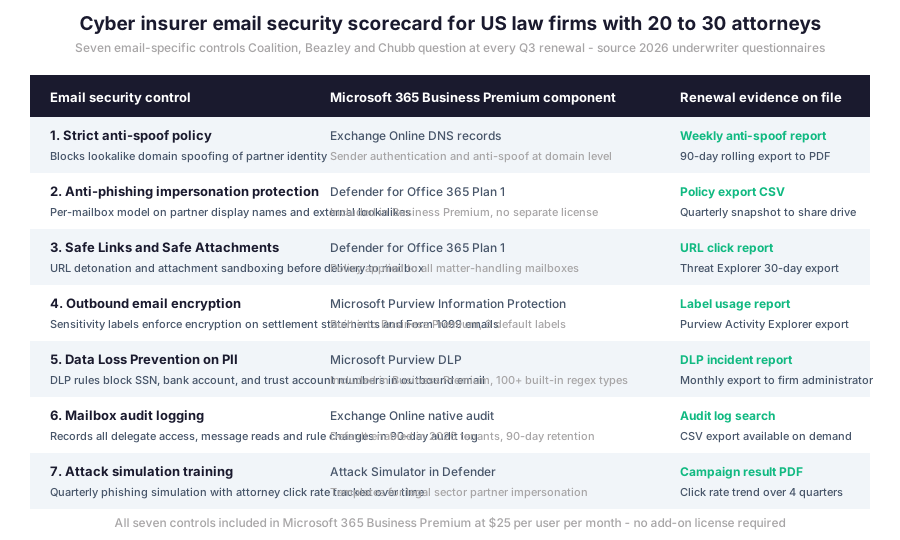
Law firm email security underwriter pitfalls and Business Premium fix
Specifically, the table below maps the six common pitfalls on a generic email stack to the Business Premium fix that satisfies the renewal questionnaire.
| Underwriter question | Generic email stack answer | Microsoft 365 Business Premium answer |
|---|---|---|
| anti-spoof policy enforced | monitor mode with no summary report visibility | strict enforcement with weekly weekly anti-spoof report on file |
| Anti-phishing impersonation | Generic spam filter blocks known malware signatures | Defender for Office 365 per-mailbox impersonation intelligence on partner list |
| URL detonation on click | Static URL reputation lookup only | Safe Links time-of-click sandbox for every URL including six-month-old emails |
| Outbound encryption | Manual PDF password sent in a follow-up message | Sensitivity label that auto-encrypts settlement statements and PII attachments |
| Data loss prevention | No DLP rules on SSN, bank account or trust account numbers | Purview DLP with 100+ regex types blocking outbound PII to external recipients |
| Mailbox audit log | Disabled by default or 30-day retention | Default enabled in 2026 tenants with 90-day retention and CSV export |
👤 Departing associate data exfiltration risk
In practice, the departing associate is the second most common source of client information leakage after BEC fraud. Specifically, the associate who plans to join a competing firm typically auto-forwards select matter emails to a personal Gmail address in the 60 days before resignation. Furthermore, the same associate downloads attachments to a personal Dropbox or USB drive. As a result, the firm loses control of confidential client communication. The privilege gets exposed at a deposition six months later when the competing firm produces the documents. Therefore, the platform needs three controls: an outbound DLP rule that blocks bulk attachment download to personal email, a mailbox audit log that records every delegate access, and a sensitivity label on every matter that prevents external forwarding.

💼 Per-attorney cost defense for a 25-attorney practice
Specifically, the 25-attorney firm pays $625 per month TCO for Microsoft 365 Business Premium at $25 per user per month. Furthermore, the price covers the email stack plus the device management plus the SharePoint matter library plus the Teams communication. Therefore, the per-attorney email security cost lands below $9 per month for the email portion of the bundle. By contrast, the multi-vendor stack costs more. Gmail Workspace Business Standard runs $14 per user per month. A third-party email security gateway adds $4 to $8 per user per month. A anti-spoof policy service adds $2 per user per month. As a result, the firm pays $20 to $24 per attorney on email alone.

Platform consolidation vs SaaS sprawl per attorney
Specifically, the SaaS sprawl story repeats across every 25-attorney US firm we audit. The firm pays a primary email subscription, an anti-phishing add-on, an encryption gateway, a anti-spoof policy service, an archiving service, and a third-party MFA. As a result, the firm administrator manages six bills, six renewal dates, six audit log formats and six vendor support contacts. Furthermore, the carrier renewal questionnaire still triggers six separate evidence exports each year. By contrast, the firm on Business Premium runs one bill, one renewal date, one admin console and one log export pipeline.
| Email security component | Multi-vendor stack per attorney per month | Microsoft 365 Business Premium |
|---|---|---|
| Primary mailbox and calendar | $14 (Gmail Workspace Business Standard) | $25 includes everything below |
| Anti-phishing impersonation protection | $4 to $8 add-on gateway | Included |
| anti-spoof policy management and reporting | $2 dedicated service | Included |
| Outbound encryption gateway | $3 dedicated service | Included |
| DLP for PII and trust account numbers | $2 dedicated service | Included |
| Attack simulation training | $3 phishing simulation service | Included |
| Mailbox archive and 90-day audit | $2 archive service | Included |
| Total per attorney per month | $30 to $34 | $25 |
📁 Evidence preservation, litigation hold and the bar audit trail
Critically, every state bar imposes a record retention period on email communications related to closed matters. Specifically, the period ranges from 5 years in California to 10 years in New York. Furthermore, the Microsoft Purview retention policy applies at the mailbox level. Therefore, email evidence cannot be deleted by an associate clicking the wrong file. In addition, the Purview litigation hold freezes a custodian mailbox within 60 seconds. The partner triggers the hold from the admin console. As a result, the firm preserves the email evidence chain even if the custodian later deletes a message. By contrast, the same discipline on a generic email provider requires a manual export workflow. Nobody runs it reliably under deadline pressure.

For the full e-discovery, litigation hold and bar audit workflow including ABA Formal Opinion 483 incident response, the dedicated guide is the next resource: Email as Legal Evidence for US Law Firms.
❓ FAQ on the law firm email security decision
Specifically, the five questions below cover platform selection, anti-spoof policy rollout, ABA Rule 1.6(c) compliance, cyber insurer readiness and the departing associate workflow.
Law firm email security platform selection and anti-spoof policy rollout
Microsoft 365 Business Premium at $25 per user per month delivers the seven email-specific controls every cyber underwriter expects at renewal. Specifically, anti-spoof enforcement, Defender for Office 365 anti-phishing, Safe Links, outbound encryption, DLP for PII, mailbox audit logs and attack simulation training. Furthermore, the bundle includes SharePoint, Teams and Intune device management. As a result, the firm runs one tenant, one bill and one audit trail.
In practice, the IT vendor runs the rollout end to end in 90 days with zero email service interruption. First, the firm publishes the anti-spoof policy in monitor mode on day one. Second, the weekly anti-spoof report identifies every legitimate sender the firm uses, including Clio, Microsoft 365 and the accounting platform. Furthermore, each gets added to the firm sender list before enforcement. Third, the policy moves to warning mode at day 30 and to strict enforcement at day 90. As a result, no legitimate email gets blocked during the staged rollout.
ABA Rule 1.6(c) and cyber insurer renewal questions
Specifically, ABA Rule 1.6(c) requires the attorney to make reasonable efforts to prevent the unauthorized disclosure of client information. Furthermore, Business Premium delivers MFA at the identity layer, anti-phishing at the email gateway, encryption on outbound matter communications and DLP on PII. In addition, the firm administrator exports the policy evidence on demand for any bar grievance hearing. As a result, the platform satisfies the reasonable efforts standard under the current ABA interpretation and the 2026 state bar opinions that reference Opinion 477R and 483.
In practice, the renewal questionnaire asks for seven specific email controls: strict anti-spoof policy with weekly evidence report, partner impersonation protection, URL and attachment sandbox, outbound encryption on sensitive matter mail, data leak prevention on PII and trust account numbers, mailbox audit logging at 90-day retention, and quarterly phishing simulation with attorney click rate metrics. Therefore, the firm administrator exports the seven evidence items from the Microsoft 365 admin console as PDF or CSV for the underwriter file. As a result, the renewal closes in one round rather than the 41 percent of applicants that get denied at first submission per the 2024 Marsh McLennan US Cyber Insurance Market Update.
Departing associate workflow questions
Specifically, the firm administrator activates three controls on a 30 to 90 day departure window. First, a DLP rule blocks bulk attachment download to personal email destinations. Second, a sensitivity label on matter folders prevents external forwarding by default. Third, the mailbox audit log records every delegate access and message read with 90-day retention. Furthermore, the firm can run a Purview Content Search across the departing associate mailbox to verify what was accessed in the final 60 days. As a result, the firm preserves the privilege chain even if the associate later joins a competing practice.
🎯 Get a productized Microsoft 365 audit tailored to your law firm
Full Microsoft 365 environment audit tailored to a US law firm: email security control inventory, anti-spoof policy posture review, ABA Rule 1.6(c) compliance mapping, cyber insurer readiness check. Delivered as a written report with prioritized recommendations, plus 14 days of email Q&A after delivery.