

Moreover, most US small businesses run on trust, not a security team. So when a breach hits, no one on staff catches it or explains it to a client. In addition, that gap is what small business cyber security consulting closes: expert help that finds and fixes your real risks before an attacker does. See the CISA for the official guidance.
Notably, you do not need a full-time security hire to be safe. Furthermore, instead, you need a clear view of your exposure, a ranked plan to fix it, and an owner to keep it that way. On top of that, most of those tools already sit inside your Microsoft 365. Similarly, the real work is switching them on correctly and proving they hold.
🛡 Not sure where your business is actually exposed?
Wintive gives US small businesses practical cyber security consulting built on Microsoft 365. That said, we audit your tenant, rank the real risks, and fix what matters first. Across 60+ M365 tenants, the same gaps recur, so you get a hardened setup and the proof clients and insurers want.
📅 Book a Free 30-Min Call | 💬 Chat on WhatsApp | See Our Plans →
This guide walks the whole engagement from first audit to steady state. First, it shows why small businesses are targeted and what a consultant actually changes. Then it covers layered defense, where breaches start, the cost math, and your first 90 days.
🛡 Why small business cyber security consulting pays for itself
📌 TL;DR — small business cyber security consulting turns your Microsoft 365 into a tested, layered defense and gives you the proof insurers and clients want.
Security spending feels abstract until something breaks. The math, however, is not. One ransomware hit can cost more than a year of profit. Prevention, by contrast, costs a fraction of that.
The gap that gets closed
In practice, your IT person keeps things running, and that is a different skill from hardening them against a motivated attacker. Specifically, a consultant looks at identity, email, devices and data as one system, finds the weak seam, and ranks fixes by real risk. As a result, you stop guessing and start spending only where it moves the needle.
Good consulting also thinks in layers, not single fixes, because no one control ever stops everything. Therefore, the point of depth is simple. If a single layer fails, the next one still holds the line. Of course, an attacker has to beat all of them in sequence to reach anything that matters.
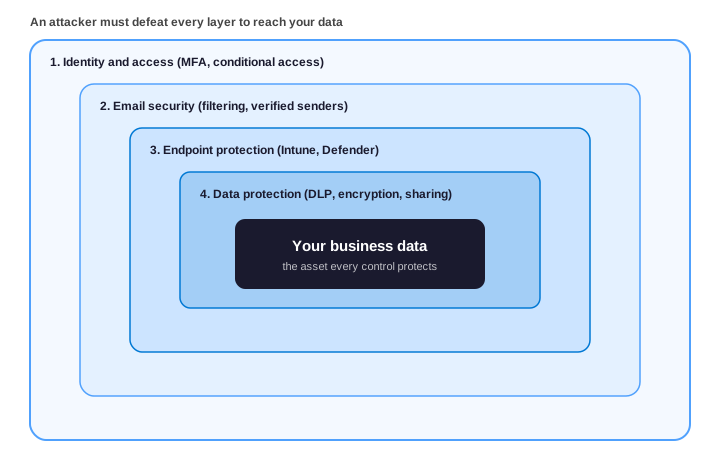
For that reason, each layer here is something Microsoft 365 can already do once it is configured and tested correctly. Notably, that is the real leverage a good consultant brings to the table. Even so, they turn the licenses you already pay for into a layered defense that an outsider would struggle to get through unnoticed.
🎯 You are a target, not an exception
💡 The hard part is not buying tools. By comparison, it is knowing which gaps matter and proving they are closed — which is exactly the job a consultant does.
| Service | What it does for a small business |
|---|---|
| Risk assessment and audit | Finds and ranks the gaps an attacker or insurer would hit first |
| Virtual CISO (vCISO) | Part-time security leadership without a full-time hire |
| Penetration testing | Safely simulates an attack to prove what holds and what fails |
| Security awareness training | Teaches staff to spot phishing, the cause of most breaches |
| Managed detection and response | Watches your tenant around the clock and reacts to threats |
| Dark web monitoring | Alerts you when staff logins show up in a breach dump |
| Incident response planning | A tested playbook so a breach does not become a panic |
| Business continuity and backup | Keeps you running when ransomware or deletion strikes |
Why attackers prefer easy targets
Attackers are not picking on you personally; they are playing the odds. Specifically, automated tools scan millions of inboxes and logins, and small businesses tend to have weaker defenses and fewer people watching. As a result, you are often easier to breach than a large enterprise and still worth real money to them.
The myth that drains owners
The belief that we are too small to be a target is the single most expensive assumption in small business security. By contrast, the firms that fare best assume they will be probed and prepare for it. Furthermore, that mindset is exactly what a consultant installs alongside the technical fixes.
🔍 What small business cyber security consulting actually covers
Moreover, a good engagement is not a vague security review. Specifically, small business cyber security consulting maps every domain that matters — identity, email, endpoints, data, backup and monitoring — against where you are today and where you need to be. Finally, it turns that map into a short, ranked list of fixes.
In addition, the fastest way to see the work is a maturity view. Notably, in practice, most small businesses sit at ad-hoc or basic across the board. Furthermore, the consulting job is to move each domain up to managed or proven, starting with whatever is riskiest right now.
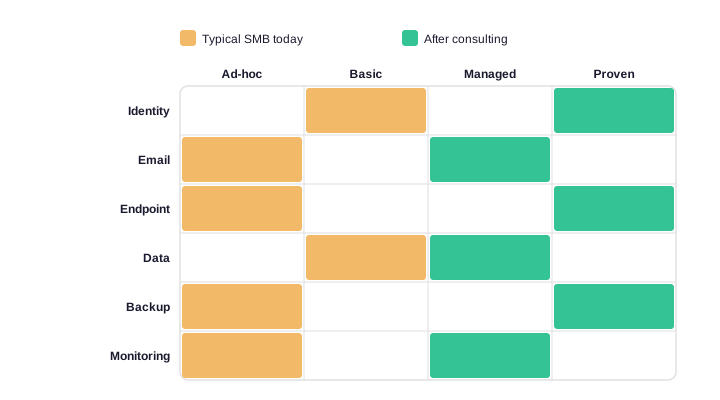
Notice that the goal is not perfection everywhere at once. By contrast, it is steady, prioritized progress: fix the gaps that an attacker or an insurer would hit first, then keep climbing on a schedule while the rest of the stack holds steady.
From audit to a ranked action plan
On top of that, the deliverable that matters is the plan, not the report. Specifically, you should walk away with a ranked action list, an owner for each item, and a realistic timeline. As a result, the audit stops being a document that sits in a drawer and becomes work that actually gets done.
The core services an engagement includes
Consulting is not one task; it is a set of services you buy together or in stages. Specifically, a consultant assembles the pieces below into a single plan. Similarly, they run the ones that close your biggest gaps first. However, you do not need all of them on day one.
Most small businesses start with a risk assessment, then layer on training, monitoring and a tested backup. By contrast, a larger or regulated firm may add a vCISO and regular penetration testing from the start. Notably, the right mix depends on your data, your clients and the rules you answer to.
When penetration testing is worth it
Penetration testing deserves a closer look, because it answers a question configuration cannot. Specifically, a tester behaves like a real attacker and tries to break in, then reports exactly what worked. As a result, you learn whether your defenses hold under pressure, not just whether they are switched on. Notably, most small businesses do not need monthly tests; an annual or post-change test is usually enough.
🧱 Layered defense, built on tools you already own
Here is the part that surprises most owners: you are probably paying for the defense already. Specifically, Microsoft 365 Business Premium includes advanced email filtering, device management, conditional access and data controls that Business Standard simply does not. That said, in practice, the gap is rarely the license; it is the configuration.
In practice, the table below shows how each defensive layer maps to a control you already own. Notably, a consultant configures each one and tests that it behaves under pressure. They then document the result, so you can prove it later to a client or an insurer.
| Defensive layer | What it stops | Microsoft 365 control |
|---|---|---|
| Identity | Stolen or guessed passwords | MFA, conditional access |
| Phishing and fake invoices | Advanced filtering, verified senders | |
| Endpoint | Lost laptops and malware | Intune, Defender for Business |
| Data | Oversharing and leaks | DLP, sensitivity labels, sharing limits |
| Backup | Ransomware and deletion | Versioned backup, retention policy |
Configured together, these layers stop the attacks that actually hit small businesses: phishing, stolen passwords, ransomware and accidental data leaks. Furthermore, they generate the logs and evidence that make a cyber insurance renewal or a client security review far less painful.
Identity, email, endpoint and data
Of course, if you only fix four things, fix these. Specifically, enforce MFA on every account, filter email properly, manage devices with Intune, and control how data is shared outside the company. By contrast, skipping any one of them leaves an open door that the other three cannot fully cover.
Zero trust and secure remote access
Remote and hybrid work moved the perimeter from your office to every laptop and phone. As a result, the old idea of a trusted internal network no longer holds. Zero trust replaces it with one rule: never assume, always verify. For that reason, in practice, Microsoft 365 conditional access checks the user, the device and the risk on every sign-in. Critically, that is configuration you already own in Business Premium, not another product to buy.
📊 Where breaches really start (and what to fix first)
Owners often picture a hooded hacker breaking through a firewall. However, the overwhelming majority of small business breaches start with something far more ordinary: a convincing email, a reused password, or a setting nobody changed. That is good news, because the fixes are practical rather than exotic.
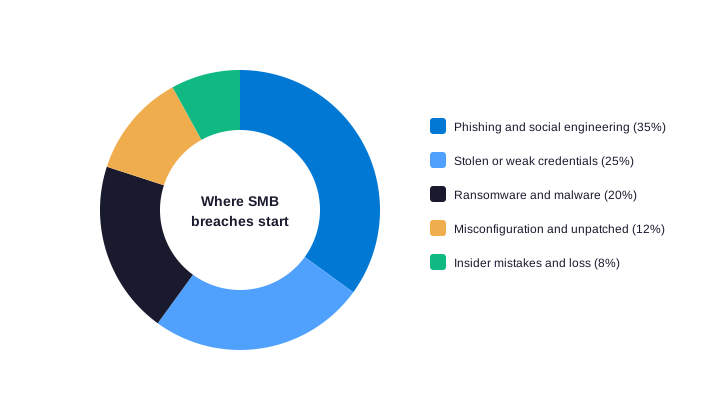
Read the chart as a to-do list in priority order. Notably, phishing and stolen credentials together account for most incidents. Even so, that is why a consultant starts with email filtering and MFA before anything else. Fix those two, and you close the doors attackers use most often.
The four risks behind most incidents
Phishing tricks a person, stolen credentials skip the trick entirely, ransomware locks what it reaches, and misconfiguration leaves a door propped open. Notably, every one of them is preventable with controls Microsoft 365 already offers. The consultant’s value is sequencing those fixes so the riskiest gap closes first, not last.
Stolen credentials deserve special attention, because they are the quietest way in. Specifically, staff often reuse a work password on a site that is later breached. Those logins then surface on the dark web for anyone to buy. As a result, dark web monitoring and enforced MFA work as a pair. By comparison, the monitoring warns you that a password is exposed, and MFA makes sure that password alone is not enough.
💸 What small business cyber security consulting costs versus a breach
Moreover, the honest comparison is not consulting versus nothing; it is consulting versus the cost of an incident. One is a planned, modest number you choose. By contrast, the other is an unplanned, often six-figure number that arrives with no warning. Seen that way, the decision gets simple.
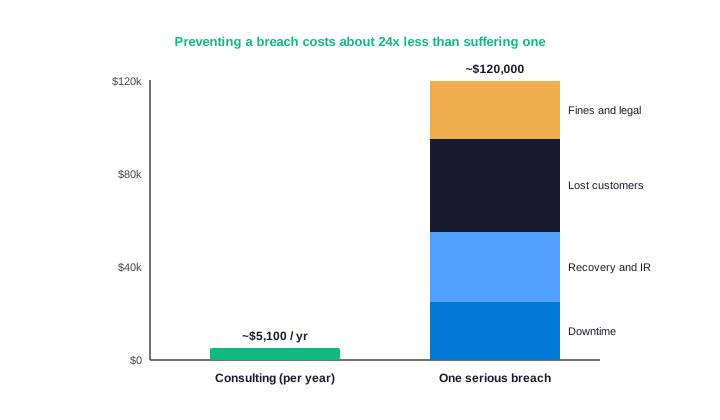
These figures are illustrative, but the ratio holds across real cases. Recovery, downtime, lost customers and legal exposure stack up quickly once an incident starts. Therefore, prevention wins on pure arithmetic, before you even count the stress it spares you.
Why small business cyber security consulting is the cheap option
Predictable spend is easier to run a business around than a surprise disaster. Specifically, you can budget a fixed monthly or project fee, show it to your accountant, and forget about it. By contrast, breach costs are unknowable until they land, and they tend to land at the worst possible moment.
| Cost factor | Consulting (planned) | One breach (unplanned) |
|---|---|---|
| When you pay | On a schedule you choose | All at once, with no warning |
| What you can budget | A predictable monthly or project fee | Unknown, often six figures |
| Business impact | Minimal, mostly your time | Downtime, lost clients, legal exposure |
| What you are left with | A hardened setup and evidence | Cleanup bills and a damaged reputation |
One more point that owners miss: prevention is an asset, not just a cost. Critically, the hardened setup and the documentation all carry forward. In addition, they lower your insurance friction and shorten every future client review. Notably, a breach leaves you with the opposite: a bill and a story you have to explain.
How small business cyber security consulting is priced
Pricing usually takes one of three shapes, and a good consultant is upfront about which one fits. Specifically, a one-time audit is a fixed project fee. Ongoing protection is a flat monthly retainer, and bigger projects are scoped and quoted first. By contrast, anyone who names a firm number before seeing your tenant is guessing. Notably, most small businesses land on a modest audit followed by a predictable monthly plan. That keeps the spend easy to budget.
🗺 What a small business cyber security consulting engagement looks like
Furthermore, a good engagement is not open-ended hand-waving; it has a clear shape. Most run through four phases, from a first audit to a steady rhythm of review. Notably, knowing the phases up front helps you spot a real consultant. On top of that, the pretenders just want a monthly retainer with no finish line.
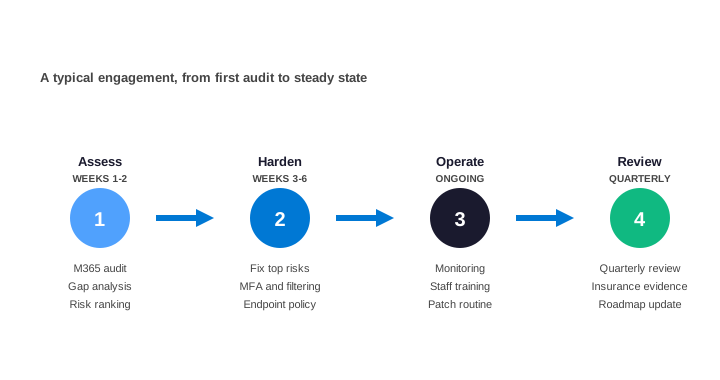
The first weeks are about discovery and quick wins; the later phases are about keeping the gains. Critically, you should see value early. The riskiest gaps should close in the first month, not at the end of a long project. Momentum in the first 30 days is a good sign.

Throughout, you stay in control. Specifically, a good consultant explains each fix in plain language and agrees the order with you. Similarly, they never make changes you do not understand. Finally, the goal is a setup you can run after they step back, not a black box only they can touch.
Assess, harden, operate, review
Assess finds and ranks your risks. Harden fixes the worst of them. Operate keeps protection live with monitoring, training and patching. Review checks the setup each quarter and refreshes the evidence. As a result, they turn a one-time cleanup into a posture that holds up as your business and the threats both change.
The operate phase is where many small businesses fall short, because protection is not a one-time project. Specifically, threats and staff both change every month, so someone has to watch the tenant, apply updates and review alerts. That said, in practice, this is where managed detection and response earns its keep. Therefore, the engagement should not end at hardening; it should hand you a clear way to keep the gains.
🔑 Compliance and insurance readiness
In practice, for many US small businesses, the trigger for hiring help is not fear of hackers; it is a form. Of course, a cyber insurance renewal, an FTC Safeguards obligation, or a HIPAA requirement suddenly demands proof you cannot produce. However, good consulting turns those demands from a scramble into a routine.
| Requirement | What it expects | What consulting delivers |
|---|---|---|
| FTC Safeguards Rule | A written security program and controls | Documented controls and a risk assessment |
| HIPAA (healthcare) | Safeguards for patient data | Access controls, encryption, audit logs |
| Cyber insurance | Proof of MFA, backup and training | Evidence that each control is active |
| Client security reviews | Answers to a security questionnaire | A ready, honest set of responses |
For that reason, the pattern is the same across all of them: someone wants evidence that your controls exist and work. As a result, once the setup is hardened and documented, answering an insurer or a healthcare or financial-services client becomes a matter of pulling the proof, not inventing it under deadline pressure.
The evidence underwriters now demand
Insurers have tightened up. Specifically, a renewal often asks whether MFA is enforced everywhere, whether backups are tested, and whether staff get phishing training. Answer no, and your premium jumps or coverage disappears. As a result, a consultant makes sure every honest answer is yes, and that you can show it.
Underneath the specific rules sits a common backbone: recognized security frameworks. Specifically, most US guidance points back to the NIST Cybersecurity Framework and the CIS Controls. Both group security into clear, prioritized steps. Notably, a consultant maps your Microsoft 365 setup to those frameworks. One body of work then satisfies an insurer, a client questionnaire and a regulator at once.
🧰 The Microsoft 365 advantage you already own
Even so, the reason Wintive builds on Microsoft 365 is leverage. Compared with bolting on separate products, such as Okta for identity or a standalone backup service, Business Premium folds most of those capabilities into one license at a predictable cost you can forecast. As a result, you get a lower total cost of ownership (TCO), fewer gaps, and a setup you can maintain.

By comparison, the catch is that Business Premium ships with most controls switched off or set to loose defaults. A common mistake is assuming those defaults are safe; in practice, controls that look active can silently fail when no one is watching. So the advantage is real, but only once someone configures the tenant deliberately and proves each control behaves.
Business Premium as a defense platform
Treated properly, Business Premium is not just email and Office; it is a security platform. Specifically, it carries identity protection, device management, threat filtering and data controls in one place. Therefore, a consultant’s job is to wire those pieces together into a coherent defense, not a pile of half-configured features.
👍 How to choose small business cyber security consulting
Not every provider that calls itself a security consultant is one. By contrast, some sell a monthly retainer with no defined outcome; others run a generic checklist and leave. However, the good ones share a few clear traits, and you can spot them before you sign anything by asking the right questions.
| What to check | Why it matters |
|---|---|
| They start with an audit | A real plan has to know your actual gaps first |
| They rank fixes by risk | You spend on what matters, not a generic list |
| They explain in plain language | You stay in control and can run the setup yourself |
| They build on what you own | Fewer extra tools means fewer gaps and lower cost |
| They leave you evidence | You can prove controls to insurers and clients |
Watch for two red flags in particular. First, anyone who quotes a price before seeing your environment is guessing. Second, anyone who cannot explain a fix in words you understand is either hiding complexity or does not grasp it themselves. Notably, a good consultant is happy to show their work.
Questions to ask before you sign
Ask what the first 30 days produce, how they rank risk, and what you are left with when the engagement ends. Furthermore, ask whether they build on your existing Microsoft 365 or push you toward extra products. Critically, the answers tell you whether you are buying outcomes or just hours.
One option many owners have not heard of is a virtual CISO. Specifically, a vCISO gives you part-time access to senior security leadership. Moreover, that is the person who sets strategy, owns risk decisions and talks to your insurer. By contrast, a full-time CISO is far beyond most small business budgets. Notably, a fractional vCISO suits a regulated firm or one chasing larger contracts. In addition, it is the cheapest way to act like a much bigger company on security.
What small business cyber security consulting delivers in 90 days
Expect MFA enforced everywhere, email filtering tuned, devices managed, data sharing controlled, and backups tested. Furthermore, you should hold a written risk assessment and the evidence an insurer or client will ask for. Therefore, that package is what turns a vague worry into a posture you can prove.
🧮 Engaging a Consultant: What the First Quarter Looks Like
How small business cyber security consulting starts
Hiring a consultant feels risky, so most owners put it off for months. Notably, in practice, a clean kickoff removes that fear quickly. First, the consultant audits your network, your devices, and every user account. Then they document what they find and rank the gaps that put data at risk. Within two weeks, the urgent holes get a plan. As a result, you see real value before the first invoice clears. From that first week, small business cyber security consulting earns trust by fixing what hurts most.
Good small business cyber security consulting never rips everything out on day one. Instead, the consultant stabilizes the basics first and improves on a schedule you approve. Meanwhile, your team keeps working without interruption. Because downtime costs more than any fix, the rollout is paced around your busiest weeks. Therefore, the transition stays almost invisible to staff. Furthermore, they simply notice faster, safer logins over time.
What you should measure after the engagement
Numbers tell you whether the work paid off, so track them from week one. On top of that, for example, watch how fast incidents get contained and how often staff report phishing. Still, raw speed is not the whole story. The deeper win is fewer incidents over time, because proactive monitoring catches threats early. Good consulting also shrinks your audit prep, since the evidence is collected as you go. Similarly, in short, the right partner turns security into a habit rather than a scramble.
Finally, review the relationship every quarter, not once a year. That said, a strong consultant brings a roadmap, not just a report. Together you rank the next projects by risk and payback. In practice, that way, the program stays aligned with where the business is heading. Ultimately, the goal is steady protection and a network you can stop worrying about. When that happens, security fades into the background and the real work takes over.
📚 More for US owners and operators
🔒 See exactly where your business is exposed
Of course, it is a full Microsoft 365 security audit for a US small business. Specifically, it reviews your identity, email, device and data controls, finds every gap, and ranks the fixes by real risk. As a result, you get a written report with a clear action plan and the evidence to show insurers and clients.
❓ Small business cyber security consulting: frequently asked questions
For that reason, these are the questions US small business owners ask us most before bringing in outside security help.
Common small business cyber security consulting questions
It is outside expertise that finds the real security risks in your business, ranks them, and fixes the ones that matter first, usually using the Microsoft 365 you already pay for.
Most small businesses spend a few thousand dollars a year, far less than a single breach. A one-time audit plus an ongoing plan keeps the cost predictable.
Usually yes. Keeping systems running is a different skill from hardening them against attackers. A consultant focuses only on security and the evidence behind it.
For most small businesses, yes. Business Premium folds identity, device, email and data protection into one license, so you rarely need add-ons like Okta or a separate backup service.
The riskiest gaps usually close in the first month. Full hardening and the evidence for insurers or clients typically follow within the first ninety days.